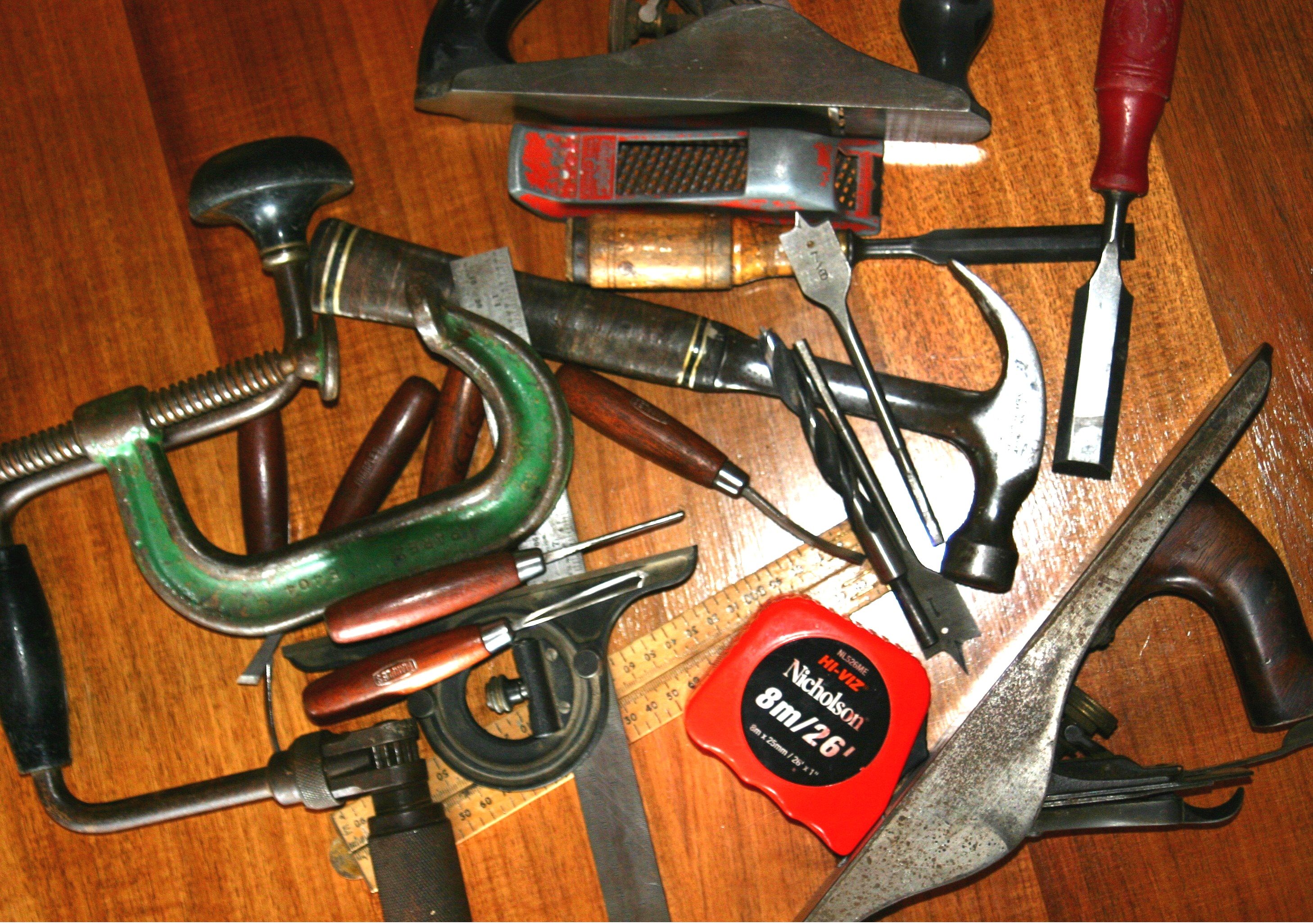
Starting a woodworking practice does not require a shop full of power tools. A carefully chosen set of hand tools covers most tasks in furniture building, box making, and general carpentry — and many experienced woodworkers in Poland keep hand tools as their primary instruments even after adding machines to their workshops.
This article covers the tools worth prioritising when setting up for the first time, based on what proves most useful across a range of early projects.
Measuring and marking
Precise layout work determines the accuracy of every cut and joint. Before cutting anything, a project must be measured and marked clearly on the wood surface.
Marking gauge
A marking gauge scribes a line parallel to an edge at a set distance. The wheel-style gauge, with a small cutting disc rather than a pin, produces a cleaner line in both long grain and end grain. It is used constantly when fitting joints or laying out tenons. Entry-level gauges from brands such as Veritas or Crown are available in Polish tool shops and online retailers like Allegro.pl for around 80–150 PLN.
Combination square
A 300 mm combination square checks 90-degree and 45-degree angles, measures short distances, and marks lines. The blade should slide smoothly and lock firmly. Cheap squares with loose blades introduce cumulative errors across a project. Japanese-made squares by Shinwa are widely considered reliable for their price range.
Marking knife
A marking knife cuts directly across wood fibres, leaving a hairline that a pencil line cannot match in precision. When chopping dovetails or fitting mortises, knife lines give the chisel a shoulder to register against.
Cutting: saws
Hand saws have two primary cuts: rip (along the grain) and crosscut (across the grain). Tooth geometry differs between the two, though general-purpose saws handle both with acceptable results for most home projects.
Panel saw
A 500–550 mm crosscut panel saw handles cutting solid timber and sheet goods to rough size. Teeth around 7–8 TPI (teeth per inch) balance speed and surface quality. Hardpoint saws — with hardened teeth that stay sharp longer but cannot be resharpened — are cost-effective for occasional use. Brands like Bahco and Stanley are stocked in most Polish hardware stores (Castorama, Leroy Merlin).
Tenon saw
A tenon saw (or back saw) has a stiffening spine along the top of the blade, which keeps the cut straight. With 14–16 TPI, it produces clean cuts for joinery work: tenon shoulders, dovetail tails, box joints. A 250 mm blade suits most furniture-scale work.
Japanese pull saw
Pull saws cut on the pull stroke, which keeps the blade under tension and allows a thinner kerf. They are particularly effective in hardwoods and for flush-trimming pegs and dowels. Gyokucho and Z-Saw brand saws are available through Polish import distributors.
Cutting: chisels

Chisels are used for chopping waste from mortises, paring joints to fit, and cleaning up saw cuts. A set of four bench chisels — 6 mm, 12 mm, 19 mm, and 25 mm — handles most tasks encountered in early projects.
Bench chisels
Bench chisels with a flat back and bevel-edged sides are the standard type. Ashley Iles and Two Cherries (Zwilling) are mid-range options that hold an edge without excessive brittleness. After purchase, the backs must be flattened on sharpening stones and the bevels ground to the desired angle, typically 25–30 degrees for general use.
Mallet
A wooden or composite mallet drives chisels without damaging the handle. Lignum vitae mallets are the traditional choice, but modern urethane mallets by Narex or similar brands distribute force evenly and do not split. A 300–350 gram head weight suits bench chisel work.
Planing
Hand planes smooth surfaces, flatten boards, and fit joints to precise dimensions. For a first toolkit, two planes cover most situations.
No. 4 smoothing plane
The No. 4 smoothing plane (about 240 mm long) prepares surfaces for finishing. Set with a fine cut and a sharp iron, it removes machine marks and tearout, leaving a surface that typically needs no sanding. Vintage Stanley and Record planes in serviceable condition appear regularly at flea markets in Warsaw and Kraków for 60–120 PLN and can be restored with basic sharpening work.
Block plane
A low-angle block plane trims end grain cleanly and fits small joints. At 150–165 mm, it is compact enough to use one-handed. The Veritas Standard Angle block plane is well regarded in the hand tool community for its adjustable mouth and consistent manufacture.
All edge tools — chisels, plane irons, marking knives — must be sharp to work correctly. A two-stone progression (a coarser stone at 1000 grit and a polishing stone at 6000–8000 grit) covers most needs. Japanese water stones are widely available in Poland; Suehiro and King brands offer reliable options. The Popular Woodworking sharpening guide covers the technique in detail.
Clamping
Clamps hold glued assemblies under pressure until the adhesive cures and keep workpieces still during layout and cutting.
F-clamps and bar clamps
F-clamps (also called speed clamps) in 300 mm and 600 mm lengths handle most glue-ups for boxes, frames, and panels. Bar clamps with a longer reach are needed for wide panels. Bessey and Irwin clamps are stocked at Leroy Merlin and larger hardware distributors in Poland.
Pipe clamps
Pipe clamp heads thread onto standard plumbing pipe, giving effectively unlimited reach at low cost. The plumber's pipe is cut to length as needed. This makes them a practical choice when budget constrains the purchase of dedicated long bar clamps.
Building the toolkit incrementally
There is no need to acquire all of the above at once. A logical starting sequence: marking gauge and combination square first, then a crosscut saw and four bench chisels, then a smoothing plane, then clamps as projects require them.
Quality second-hand tools from Polish online marketplaces (OLX, Allegro) significantly reduce the cost of entry, particularly for vintage planes and chisels that respond well to restoration.
Further reading on tool selection and hand tool techniques is available from Fine Woodworking and the Hand Tool School, both of which publish detailed project-based instruction.